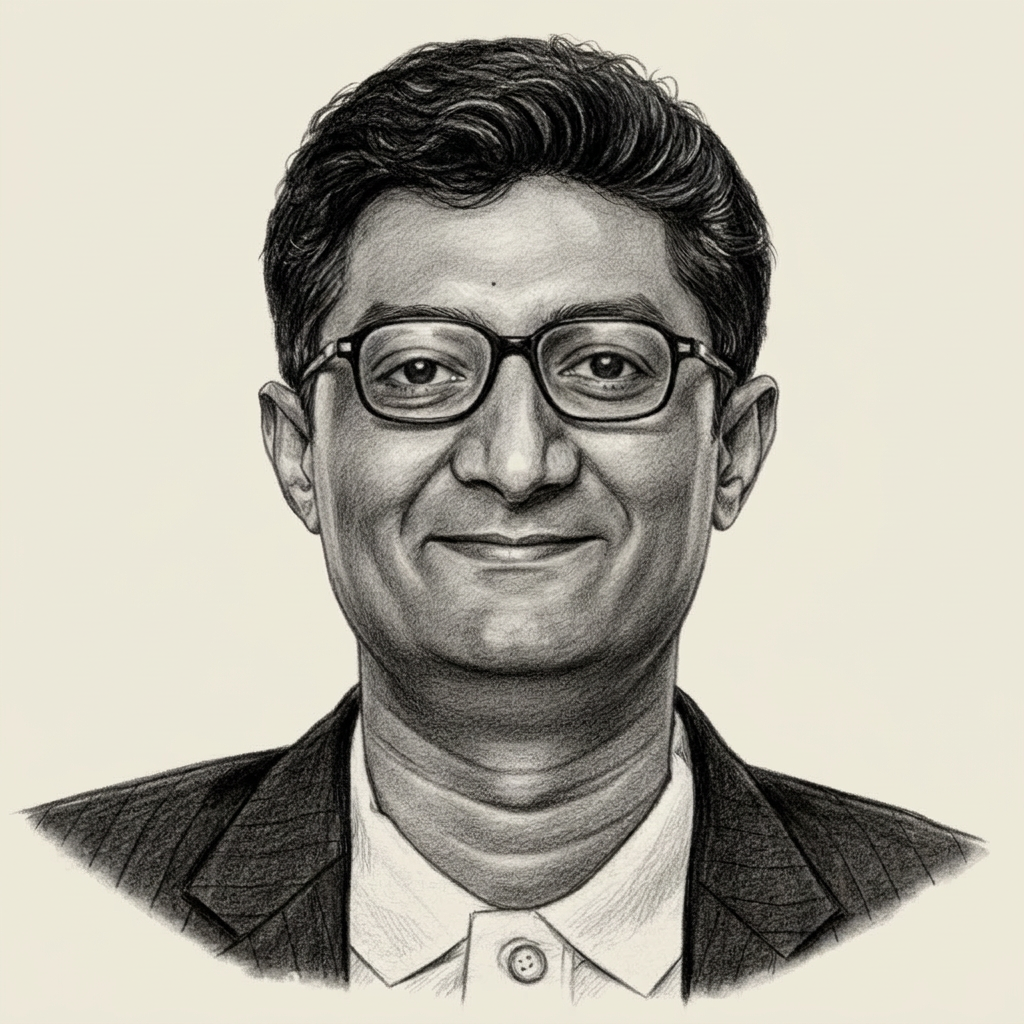
A 2017 video of Vishal Sikka popped up on my YouTube timeline — and I got intrigued. Link in comments.
The reason was not that I am not aware who Sikka is or his credentials. I wanted to understand his thoughts on AI back then when it was not a buzzword. Was he working on any AI projects or POCs for Infosys customers?
That was the only reason I wanted to watch this interview of Vishal Sikka initially but as I watched the full episode, I realized it can actually be a case study on how to transition (non-transition too) leaders you hire from outside your organization.
But before I talk more about this and what all lessons to learn from the Vishal Sikka – Infosys saga, let me share how Vishal Sikka actively pushed Infosys to go “AI-first.” Nine years ago. Well before the AI boom most of us are scrambling to respond to today.
How Vishal Sikka Was Building an AI-First Infosys — Nine Years Ago
Once he got onboarded as the CEO, he kicked off his journey to understand Infosys customers. To achieve that he ran a customer survey and found something uncomfortable.
Infosys scored high on quality, delivery, and professionalism. But clients didn’t see it as proactive or innovative. No strategic relevance.At the time, Infosys was running 9,500 projects.
That feedback became the foundation of his “Zero Distance” strategy: get so close to the client that you go beyond the project brief and do something they didn’t even know they needed.
He also understood something most transformation leaders miss — technology alone doesn’t change a company. Mindset does. So he invested in training people on Design Thinking, AI, and Data Science before those words became boardroom buzzwords.
And in 2015, he was at the table with Elon Musk, Peter Thiel, and AWS to back what would become OpenAI. Infosys reportedly walked away from a $1 billion investment that could be worth $45 billion today.
Vishal Sikka’s exit from Infosys is taught in business schools as a governance case study. But most of the lessons being drawn are the wrong ones.
People focus on the Murthy-Sikka feud. The leaked letters. The personal attacks. What they miss is simpler — and more dangerous.
What Founders Need to Learn From the Infosys-Sikka Saga
Here are a few important lessons that Founders need to learn from this episode so as not to repeat the same mistakes:
1. A mandate contradiction is fatal.
Infosys wanted transformation without releasing the control that transformation demands. A leader’s results will never protect them if their authority was never clearly established to begin with.
2. Credentials are not a guarantee.
Sikka had a Stanford PhD in AI and had built SAP HANA. The founders had built one of India’s greatest institutions. On paper, a formidable combination. In practice, cultural misalignment and absent governance guardrails can dismantle even the strongest intentions.
3. Mindset is the hardest thing to change.
Nobody surrenders something they built with their own hands without a fight — least of all inside a 200,000-person organisation where every layer runs on its own version of “this is how things work here.” As Founders we need to change the mindset to bring a real change.
4. Not everyone sees the future at the same time.
Sikka was mapping AI use cases in 2016. The industry is still piecing together AI strategy in 2026 including Infosys. Whether he was early or exactly on time — the people who worked alongside him carried that thinking forward. That’s not a small thing.
5. Every action and inaction carries a price.
His exit cost Infosys $4.85 billion in market cap in a single day — and arguably a $45 billion OpenAI position. But that’s not the real loss. The real loss is the AI services leadership Infosys could have owned. The early access, the relationships, the head start no competitor could have bought at any price.
Infosys hired a transformation CEO into a structure that was never designed for transformation. Founders with significant equity, no formal governance charter, undefined decision rights, and a culture that had never had an outsider at the top.
Perhaps, Sikka was handed a title. He was never handed real authority.
And here’s the uncomfortable part for anyone running or advising any organization: This isn’t a story about one company. This pattern repeats every time a business tries to buy innovation by hiring from outside — without doing the harder work of restructuring the governance that would let that person actually lead.
What would it cost your organisation?
What would you have done differently — as a board, as a founder, or as the incoming CEO?
Nobody knows everything. The only real mistake is not course-correcting when you realise something is going wrong.
Disclainer: This post is written solely to explore leadership and governance lessons from a widely documented public event. It does not intend to project or diminish the reputation of any individual or organization involved. The author has no direct or indirect association with Infosys or Vishal Sikka in any capacity..