
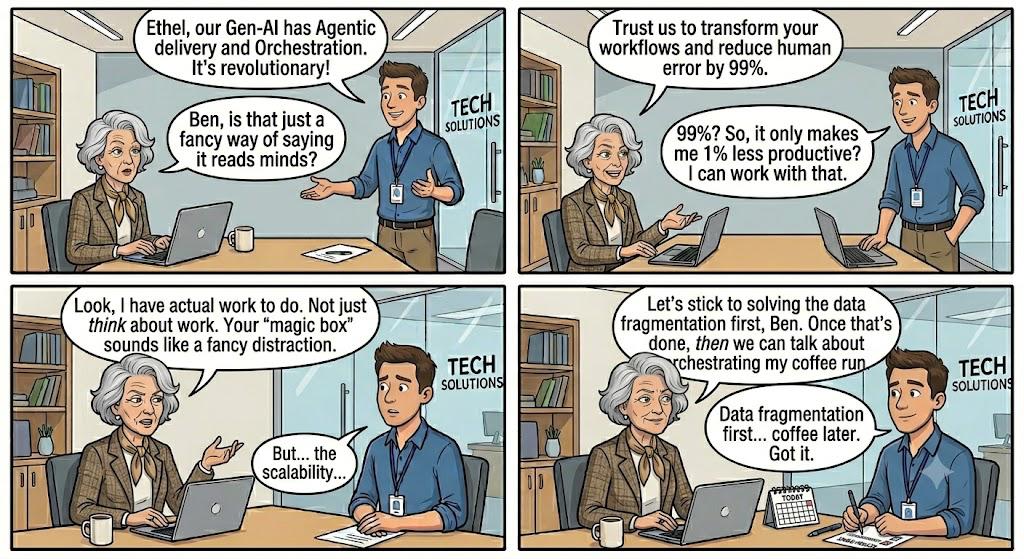
You walk into a client meeting prepared. You know your AI powered solution. You’ve rehearsed the demo. The deck looks different. But somewhere around slide four, the same words show up.
- Agentic
- Intelligent orchestration
- AI-native delivery
Your client has heard it so many times they’ve started to sound like a language nobody actually speaks.
There’s no confrontation. The client is still nodding. Asking polite questions. But something shifted and you felt it even if you can’t name it. Here’s what actually happened.
They stopped evaluating your product. They started evaluating you.
Most AI pitches aren’t really about AI. While you’re talking about models, automation, agents, the client is trying to answer a completely different question. They’re asking themselves: Do I trust these people? Because if this thing works, someone’s job changes. Someone’s process changes. Someone has to champion it internally. And if it doesn’t work, and they’ve seen it not work before someone’s reputation takes the hit.
That person is them.
So the evaluation was never really about your technology. It’s about whether you understand enough about their world to be worth the risk.
Two vendors can walk into the same meeting. One gives a technically brilliant presentation. The other asks three smart questions, figures out where the real headaches are, and suddenly the conversation goes somewhere completely different. The second one gets the next meeting. Not because they knew more, but because the client felt understood.
The doctor who starts prescribing before asking what’s wrong
The most frustrating thing I see IT services sales do is fall in love with what they’re selling. It’s quite understandable: you’ve spent months building something, you’re genuinely excited about it, and that excitement is real. But then they walk into a client meeting and lead with the solution before they’ve understood the problem, which is a bit like showing up at a doctor’s office where the doctor hands you a prescription the moment you sit down.
Your client didn’t wake up this morning thinking they needed some AI. They woke up thinking about why something keeps breaking, why the margins are getting squeezed, why a process that should be simple takes three days and two people to complete. The founders who struggle are trying to convince clients that AI matters, while the founders who win are trying to understand why the problem matters and those are genuinely different conversations that clients can feel from the first five minutes.
The real reason projects fail
Most AI projects that fail were already failing before the first line of code was written, and the causes are almost never technical. They are organisational and they were visible from the first conversation, if anyone had looked for them.
I’ve watched companies spend weeks debating which model to use when they still hadn’t decided who was actually responsible for the project. The model selection meeting happens because it feels like progress. The ownership question doesn’t get asked because the answer is awkward. So the project moves forward with a clear technology choice and a completely unclear accountability structure, and then six months later, everyone looks at the technology and says it didn’t work.
The pattern is consistent enough that you can almost predict failure from the first discovery call. Watch for these:
- The project is owned by IT but the business unit hasn’t been told what changes when it works.
- The data sample used in the demo is clean. The production data has never been audited.
- Different departments have different definitions of the same metric, revenue, customer, order and nobody has resolved which one the AI will use.
- The executive sponsor is enthusiastic in meetings but hasn’t committed a budget past the pilot stage.
- Success hasn’t been defined in writing. Everyone assumes they agree because nobody has tested whether they do.
The vendors who surface these problems early, who name the ownership gap before the contract is signed, who ask about the production data before the demo is over, are the ones clients remember when the project actually works. Not because they were technically superior, but because they refused to pretend the organisational problems weren’t there.
What trust actually looks like in a client meeting
Before trust becomes visible, there’s usually a question that surfaces quietly, sometimes in the first meeting, sometimes months in. It’s never asked directly, but you can feel it in how the conversation moves. The question is: have we actually agreed on what success looks like here?
Those questions are simple. Most vendors skip them because the answers slow the deal:
- Who owns this project when the vendor isn’t in the room?
- What does the data actually look like, not the cleaned sample from the demo, but the production data sitting across fifteen years of legacy systems?
- If this AI works perfectly, what changes in how your people do their jobs, and have you told them?
- Which executive is the real sponsor here, and what happens to this project if they move roles in six months?
- Have the teams whose workflows change been involved in defining what success looks like?
Most vendors don’t ask these questions because a client who admits their data is fragmented, their departments don’t agree on basic definitions, and nobody has told the operations team yet, that client sounds like a longer sales cycle. So vendors nod, move past it, and sign the contract.
That’s what makes the trust conversation so commercially important, not just relationally. The client who tells you their data isn’t ready, their ownership is unclear, and their executive sponsor is lukewarm is giving you information that most vendors never get. They’re giving it to you because they’ve decided you’ll use it to solve the problem rather than to close the deal.
You know something real is happening when the polished version of the story disappears, when someone leans forward and says: Can I be honest with you? They’ll tell you which projects are failing quietly, which teams aren’t aligned, which initiative has already burned the budget twice. That doesn’t happen because you’re the smartest person in the room. It happens because they’ve decided you’re not going to use what they tell you against them.
Most vendors end a pitch by asking what outcome the client is looking for, which sounds right and uses the correct vocabulary, clients have started nodding at it automatically. But the vendors who are actually winning say something different. They name what they’re committing to, how it gets measured, and what changes for them commercially if they don’t get there.
That second version requires answers to questions most vendors haven’t prepared for:
- What specific metric moves, by how much, and by when?
- Who on the client side owns the result alongside us, not the relationship, the actual result?
- What happens to our fee structure if the agreed threshold isn’t reached?
- What’s the kill clause, and are we both comfortable saying it out loud?
Most vendors avoid these questions because answering them means building a different contract, carrying a different risk model, and accepting a kind of exposure that T&M pricing was specifically designed to avoid.
I want to push on that a bit, though, because I don’t think it’s really about willingness, I think most vendors haven’t had to mean it yet, because the market has been forgiving enough that saying outcomes-focused was enough to get through the door without actually contracting for outcomes.
That’s one industry. But the signal is the same across enterprise IT broadly. Forrester projects that enterprises will defer 25% of planned AI spend into 2027 due to ROI concerns, which means procurement and finance teams are now involved in conversations that used to be handled by IT. The CFO isn’t interested in what model you’re running. They want to know what it costs per resolved outcome.
The question isn’t whether your technology works, it’s whether you’re willing to stand next to the client when they have to answer for it. The vendors who stay in the room when things get hard are the ones who built that expectation into the contract from the start, not the ones who showed up after the fact with an explanation.
The firms that win over the next three years won’t necessarily be the ones with the best AI, they’ll be the ones that can walk into a business, understand what’s actually slowing it down, and fix it. Sometimes AI will be part of the answer and sometimes it won’t, but the client won’t remember what model you used. They’ll remember that something that used to take five days now takes five minutes, and that you were the one willing to put your name on that outcome before the project started. The technology is just how you got there.